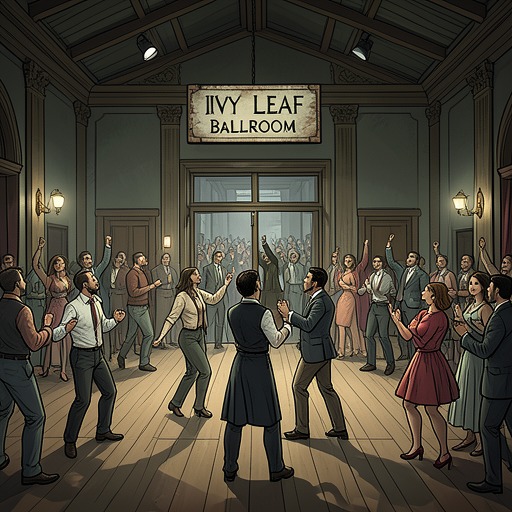
Ivy Leaf Ballroom
The Greatest Beer Run Ever: A Memoir of Friendship, Loyalty, and WarThe Ivy Leaf Ballroom was a dance hall whose appeal rested on a lasting local appetite for music, dancing, and courtship. Built by Patsy Conboy with money he had made in America, it prospered through the 1950s and into the 1960s, even as priests denounced it from their pulpits. In the narrator’s account, the ballroom is at once a place of employment and communal pleasure, and a point of contrast between local life and his father’s standards of respectability.
Origins and setting
Patsy Conboy first named the building Fenaghville. It was the forerunner of the Cloudlands and the Roselands; later it became the Ivy Leaf, a name the narrator considers more appropriate. The ballroom stood near the small farm the narrator and his wife bought: his father described that land as a “snipe run in behind the Ivy Leaf Ballroom.” The farm was a low hill between two lakes, with poor soil, and the phrase captures the contempt with which his father viewed both the land and its surroundings.
The father belonged to a world of civil servants, teachers, doctors, nurses, policemen, and tillage inspectors. A small farm near the mother’s relatives, on ground where the narrator had grown up with her, would have seemed a step down from that world. The name Ivy Leaf would have earned his disapproval too. The ballroom thus fixes the farm within a local landscape and community that the father’s social outlook rejected.
Dancing and local life
Patsy hired famous dance bands, and people travelled to the ballroom by bus, lorry, hackney car, horse trap, bicycle, and on foot. Inside, couples danced beneath spangled lights on the dusty floor; some then invited one another out to see the moon and take the air. The scale of the dancing’s effect on local courtship is conveyed in the recollection, “There wasn’t a haycock safe for a mile around in the month of July.”
The ballroom’s success also gave Patsy a substantial place in local life. It provided employment, and he became a local hero despite denunciations from several pulpits. Its popularity was not simply a matter of novelty: the narrator distinguishes the ballroom’s enduring demand from Patsy’s less successful ventures, suggesting that its rootedness in local social needs sustained it where other schemes could not.
Failed ventures and resistance
Patsy lost all the money he made from the dance hall in two ventures that were less firmly rooted in the area: a motorcycle track that became a quagmire as soon as it was used, and an outdoor, unheated swimming pool built amid hundreds of small lakes and uncertain weather. While the pool was being dug out of daub and channel, men seeking work arrived with letters from their priests explaining that they had large families to support. Patsy refused to be moved by the appeals and answered one intermediary, “My advice to you, Buster, is to dump the priest and put a cap on that oil well of yours. They have been capping such oil wells for years in America. Families are smaller and everybody is better off.” His response sets his economic bluntness against the authority of the pulpit, even as his own ventures outside the ballroom proved costly.
Ruin and narrative significance
When the narrator and his wife bought their land, the Ivy Leaf was already a ruin: its curved iron roof was rusted, its walls unpainted, and Patsy had gone blind. The remembered signs of the ballroom’s lively past—the dance bands, the crowds, the courtships—stand sharply against this neglected building and its owner’s blindness. Snipe zigzagged above the rushes nearby, while the narrator and his wife settled on the small farm and were happy there.
The ballroom’s place in the memoir is therefore not reducible to its physical decline. It helps explain why the father would have disapproved of the narrator’s chosen home, while its former prosperity records a community capable of sustaining its own pleasures and work despite clerical opposition. The narrator’s connection to the surrounding lanes and fields reaches back to the beginning of his life; returning to live there makes the once-dismissed landscape a place of chosen belonging.